The short answer
- Trimming one tree in Florida typically costs $150 to $1,200, depending mainly on height. Very tall trees cost more.
- Timing: larger cuts on shade trees from about November to February; palms at any time; storm pruning finished before June 1.
- Good pruning is modest. No more than about a quarter of the live crown in a year, and never topping.
- TreeServicesNear.me lists tree trimming companies town by town. Jump to the list.
What trimming and pruning cover
Companies use "trimming" and "pruning" for the same work. When you ask for a quote, describe the result you want. The usual jobs are:
- Cleaning. Removing dead, broken, diseased and rubbing branches. The most common job, and useful on almost any mature tree.
- Raising. Removing lower branches for clearance over a roof, driveway, sidewalk or lawn.
- Reduction. Shortening limbs back to a side branch to bring a tree away from a building or reduce the weight on an overlong limb.
- Thinning. Removing selected small branches from the outer crown. It should be light: over-thinning weakens a tree.
- Structural pruning. Guiding a young tree toward one dominant trunk and well-spaced branches. The best value of any pruning, because it prevents problems instead of fixing them.
- Palm trimming. Removing completely brown fronds and old flower and fruit stalks. Nothing green, and nothing above horizontal.
Tree Trimming Cost & Season Estimator
Choose the tree size, how many trees and what the trimming is for, to get a ballpark price range and the better months to book it. An estimate only: the real price is the written quote.
Project Parameters
Seasonal Care Recommendation
Loading recommendation details...
How to tell good work from bad
| Good practice | Warning sign |
|---|---|
| Cuts made just outside the branch collar, leaving no stub | Stubs left sticking out, or cuts flush against the trunk |
| The tree keeps its natural shape | The top cut flat or the main limbs cut to stubs (topping) |
| Inner branches kept along each limb | Limbs stripped bare with a tuft of leaves at the end (lion-tailing) |
| Palms left with a full, round head of green fronds | Palms cut to a few upright fronds (the "hurricane cut") |
| A ladder, rope or lift used to reach the crown | Climbing spikes used on a tree that is not being removed |
| About a quarter of the crown removed at most | Half the tree on the ground |
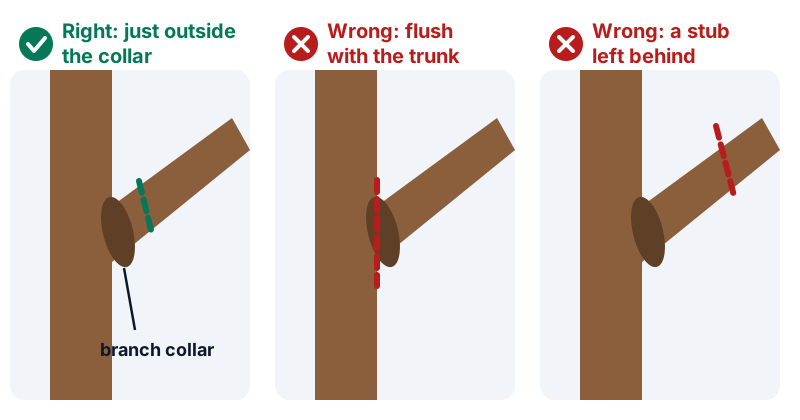
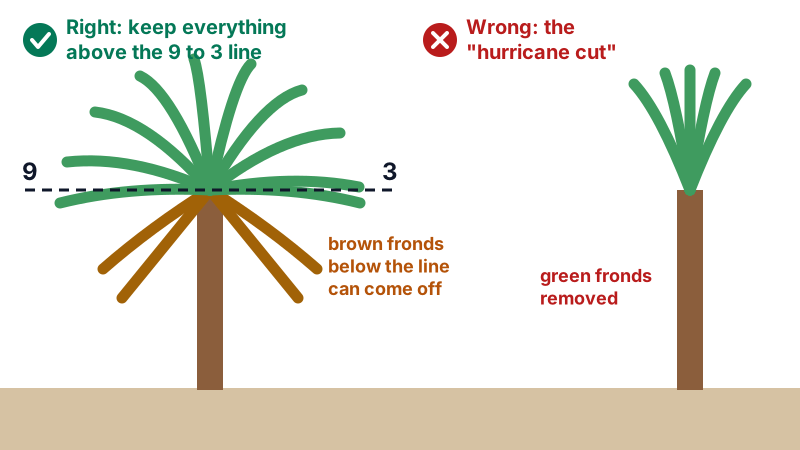
If a company proposes topping a tree or stripping a palm, look for another company.
When to book it
- Oaks and other shade trees: about November to February for larger cuts.
- Palms: any month.
- Pines: winter, because fresh cuts in warm weather attract bark beetles.
- Before hurricane season: February to May, finished by June 1.
- Dead, broken or dangerous branches: as soon as you notice them.
The month-by-month detail for each kind of tree is in when to prune trees in Florida, and the storm checklist is in the hurricane tree preparation guide.
Rules and hiring
Ordinary trimming on your own property rarely needs a permit, but some Florida towns regulate heavy pruning of protected trees, and many prohibit topping. Mangroves have their own state law and cannot be trimmed like other trees. See the Florida tree permit guide.
Florida does not license tree companies, and TreeServicesNear.me does not vet the ones it lists. Before you hire, ask for a certificate of insurance sent by the insurer, check the business is registered, read recent reviews and get the job in writing. See how to choose a tree service.
Tree Trimming companies by town
These are the Florida towns where the most listed companies offer tree trimming and pruning. Each link opens the list for that town, with phone numbers, websites and Google ratings.
- Tree Trimming in Tampa (45 companies)
- Tree Trimming in Fort Lauderdale (38 companies)
- Tree Trimming in West Palm Beach (32 companies)
- Tree Trimming in Sarasota (31 companies)
- Tree Trimming in Jacksonville (30 companies)
- Tree Trimming in Clearwater (25 companies)
- Tree Trimming in Palm Beach (24 companies)
- Tree Trimming in Coral Springs (23 companies)
- Tree Trimming in Pompano Beach (22 companies)
- Tree Trimming in St. Petersburg (22 companies)
- Tree Trimming in Valrico (22 companies)
- Tree Trimming in Jupiter (21 companies)
- Tree Trimming in Lutz (21 companies)
- Tree Trimming in Seminole (21 companies)
- Tree Trimming in Palm Bay (19 companies)
- Tree Trimming in Deerfield Beach (18 companies)
- Tree Trimming in Dunedin (18 companies)
- Tree Trimming in Palm Harbor (18 companies)
- Tree Trimming in Seffner (18 companies)
- Tree Trimming in Boca Raton (17 companies)
- Tree Trimming in Boynton Beach (17 companies)
- Tree Trimming in Nokomis (17 companies)
- Tree Trimming in Plant City (17 companies)
- Tree Trimming in Brandon (16 companies)
- Tree Trimming in Cape Coral (16 companies)
- Tree Trimming in Lithia (16 companies)
- Tree Trimming in Miami (16 companies)
- Tree Trimming in Tallahassee (16 companies)
- Tree Trimming in Coconut Creek (15 companies)
- Tree Trimming in DeLand (15 companies)
Not listed? Search by town, county or ZIP code or browse every Florida county.
Common questions
How much does tree trimming cost in Florida?
Trimming one tree in Florida typically costs $150 to $300 for a tree under 15 feet, $300 to $600 for 15 to 30 feet, $600 to $1,200 for 30 to 60 feet, and $1,200 to $2,500 for a tree over 60 feet. Work near a roof or power line costs more, and most companies charge less per tree when there are several.
How much does palm tree trimming cost in Florida?
Palm trimming is usually priced per palm and costs less than trimming a shade tree of the same height, because only dead fronds and seed stalks come off. Expect the lower end of the range for the palm's height, with a lower price per palm when a company is trimming several on one visit.
When is the best time to trim trees in Florida?
Larger cuts on oaks and other shade trees are best made in the cooler, drier months, roughly November to February. Dead, broken or dangerous branches can come off in any month, and palms can be trimmed at any time. Finish storm pruning before hurricane season starts on June 1.
How often should trees be trimmed?
Young shade trees benefit from structural pruning every two to three years. Mature trees generally need attention every three to five years, plus a check after any major storm. Palms need dead fronds removed once or twice a year. A tree that needs heavy trimming every year is usually the wrong tree for its spot.
Is topping a tree a good way to make it safer?
No. Topping, also called hat-racking, cuts the main limbs back to stubs. The tree responds with fast, weakly attached shoots that break more easily in storms, and the large wounds let decay in. Many Florida towns prohibit it. Reducing a tree properly means shortening limbs back to a side branch.
Who trims trees near power lines?
Your power company trims around its main distribution lines. Homeowners and ordinary tree crews should stay at least 10 feet from power lines; only crews qualified for line clearance may work closer. For branches near the line running to your house, call the power company before any work.
Guides that go with this
- When to Prune Trees in Florida
- Florida Hurricane Tree Preparation Guide
- How to Choose a Tree Service in Florida